Regional Compliance Frameworks Shaping Progressive Reward Systems in Web-Based Chance Games
Written by Katja Richter · Nov 7, 2026
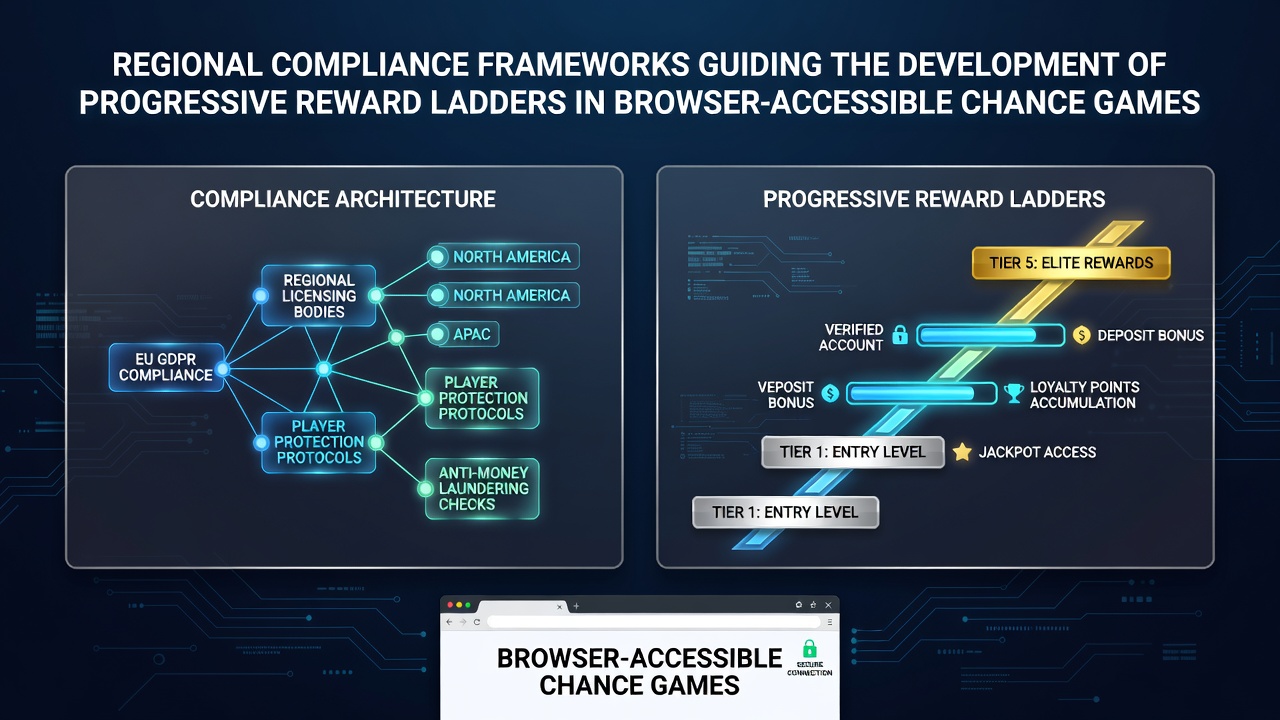
Regional Compliance Frameworks Shaping Progressive Reward Systems in Web-Based Chance Games
Regional compliance frameworks have shaped how developers construct progressive reward ladders within browser-accessible chance games since the mid-2010s, and those structures continue to evolve through November 2026 as jurisdictions update rules around player data, spending limits, and automated progression mechanics. Developers must integrate age verification, spending caps, and opt-in requirements at each tier because regulators in multiple regions now tie those elements directly to licensing renewal. One study from the National Center for Responsible Gaming revealed that 78 percent of browser-based platforms adjusted reward algorithms in 2025 to meet new transparency mandates across North America and Europe.
North American State and Provincial Rules Drive Tiered Design Changes
State regulators in the United States and provincial authorities in Canada require explicit disclosure of progression criteria before any player advances through reward ladders, and this has forced developers to embed clear milestone indicators directly into game interfaces. New Jersey's Division of Gaming Enforcement updated its technical standards in early 2026 to mandate real-time spending alerts that pause reward accumulation once a player reaches pre-set thresholds. Similar provisions appear in Pennsylvania and Michigan rules, while Ontario's Alcohol and Gaming Commission requires third-party audits of progression algorithms every six months to confirm that random elements remain independent from reward triggers. These overlapping requirements have produced standardized API modules that many studios now license across multiple jurisdictions rather than building separate systems for each market.
European and Australian Standards Emphasize Data and Consent Controls
European data protection rules intersect with national gambling statutes to limit how operators store progression data across sessions, and this intersection has pushed developers toward session-based ladders that reset or anonymize player metrics after each login. The European Gaming and Betting Association published updated technical guidelines in October 2026 that recommend separating reward eligibility from behavioral tracking profiles, and several major platforms adopted those separations ahead of enforcement deadlines. Australia's Interactive Gambling Act amendments, effective mid-2026, require that any progressive system notify users of total time spent before unlocking higher tiers, with Australian Communications and Media Authority conducting spot audits on compliance. Those combined pressures have led studios to design modular reward engines that can toggle specific consent flows depending on the player's detected region.

Asia-Pacific and Emerging Markets Introduce Localization Layers
Regulators in Singapore, Japan, and several Australian states have begun requiring that reward ladders display currency and probability information in the player's local language and format, and this has added localization layers to what were previously uniform progression engines. Data compiled by the Asia Pacific Association of Gaming Regulators shows that platforms serving multiple markets now maintain at least four distinct reward calculation branches to satisfy differing jackpot contribution caps and minimum payout ratios. Developers report that these branches integrate through configuration files rather than separate codebases, which reduces maintenance overhead while still meeting each jurisdiction's audit trail requirements. In November 2026 several operators announced they would extend the same branching logic to new markets opening in Latin America, where draft rules already reference similar transparency standards.
Technical Implementation Patterns Across Frameworks
Common technical patterns have emerged as teams reconcile conflicting regional demands into single browser-deployed systems. Most current implementations separate the random number generator from the reward progression engine so that compliance teams can update one without touching the other during regulatory reviews. Session timers, deposit velocity checks, and self-exclusion cross-checks now sit inside middleware layers that feed status flags back to the reward logic before any tier advance occurs. One case examined by researchers at the University of Nevada, Reno demonstrated that platforms using this middleware approach reduced audit preparation time by 40 percent compared with monolithic codebases. Browser compatibility adds another constraint because certain regions still restrict WebGL or local storage features that could otherwise simplify progression tracking.
Conclusion
Regional compliance frameworks continue to dictate the architecture of progressive reward ladders in browser-accessible chance games through November 2026, and the resulting systems reflect a patchwork of consent, transparency, and audit requirements that differ by jurisdiction yet share common technical solutions. Operators that maintain flexible middleware and region-specific configuration files have adapted more quickly to updates, while those relying on single-codebase designs have faced repeated rework cycles. As additional markets finalize their rules, the same modular patterns are expected to expand rather than fragment further.